Contents
Easter Island – Faces of Mystery
It is one of the most isolated islands in the world but 1200 years ago a double-hulled canoe filled with seafarers from a distant culture landed upon its shores. Over the centuries that followed a remarkable society developed in isolation on the island.
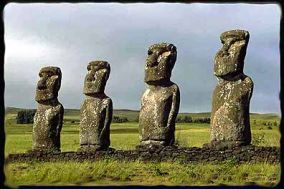
For reasons still unknown they began carving giant statues out of volcanic rock. These monuments, known, as “moai” are some of the most incredible ancient relics ever discovered. The people of Easter Island called themselves the Rapa Nui. Where did they come from and why did they disappear? Science has learned much about the enigma of Easter Island and has put to rest some of the more bizarre theories, but questions and controversies remain.
Explore this site to get the latest information on the island’s history and current research.
The Story & History
 Wild speculation about UFO’s, Atlantis, and vanished advanced ancient races has always been a part of the Easter Island debate. Science has made great strides in understanding who made the giant statues of Easter Island and has put to rest these bizarre stories. This short pictorial essay will hopefully clear up continuing misconceptions about Easter Island and perhaps will get you thinking about how the story of Easter Island relates to what we as humans are currently doing to our planet. This is a story everyone should read.
1. Arrival
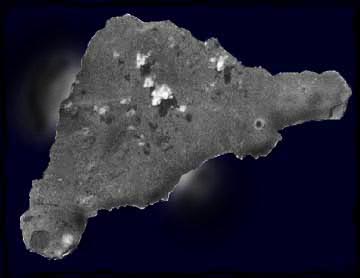
Easter Island–Rapa Nui is a tiny speck of land in the South Pacific. Formed by a series of massive volcanic eruptions, the island was only easter island from spaceinhabited by sea birds and dragonflies for millions of years. Its steep slopes, however, stood out like a beacon to a weary group of Polynesian seafarers. How long their voyage took or their reasons for leaving their home country are questions that we’ll never have the answer to, but we can imagine their joy at seeing this sight after what must have been months at sea.
Lava tubes and pounding waves have created hundreds of sea caves and a treacherous coastline. There are only a few small areas that are safe for anchorages. Located in the South Pacific between Chile and Tahiti, Easter Island is one of the most isolated inhabited islands in the world. Roughly triangular and covering only 64 square miles, it formed when a plume of hot material rose from deep within Earth’s interior, burned through the crust and erupted onto the surface as lava.
Today, volcanic cones are found at each point of the island. The largest, Rano Kau is easily visible from space. The highest is Terevaka, which rises to 11674 feet above sea level. There are over 70 eruptive centers on the island but none has known activity since the island was colonized 1300 years ago.
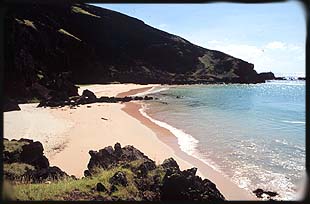 This sheltered sand beach is close to Anakena, where the legends say King Hoto Matua landed his double hulled canoe, thus beginning the occupation of Easter Island.
Anakena, a beautiful white sand beach stands out from the rest of the coastline, which is either sharp black lava rock or vertical cliff faces hundreds of feet tall.
It is at Anakena that the legends say Hotu Matua landed and began the colonization of the island. Excavations of this area have discovered that it was an important site and it boasts one of the best collections of erected moai on the island, Ahu Naunau.
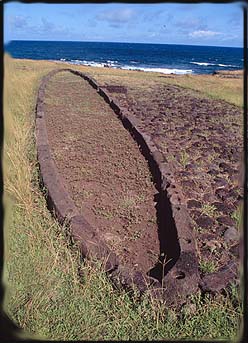
The voyagers started constructing villages and houses made in an unusual elliptical shape. It has been speculated that this style of construction started when the new arrivals turned their boats upside down for quick housing. There were literally hundreds of remains of these foundations on the island in the 1800’s, but most were destroyed by the missionaries to make fences.
 Indeed, the missionaries did more damage to the island’s history than even the Peruvian slave traders, which carted off most of the island’s population. Those who escaped by hiding in the island’s many caves were “saved” by these missionaries, who proceeded to destroy all the islanders’ wooden sculptures, religious artifacts and most importantly, the Rongo-Rongo tablets, which contained a record of the lost language of the Rapa Nui. So few of these tablets remain that no one has been able to decipher them.
The first islanders found a lush island, filled with giant palms which they used to build boats and housing. The plants they brought with them did well in the rich volcanic soil and by AD 1550 population on the island hit a high of between 7000 and 9000.
Distinct clans formed as the population increased and various population centers grew up in different areas of the island. One thing tied them all together however — the statue construction and the cult that formed around it.
2. Statue Construction
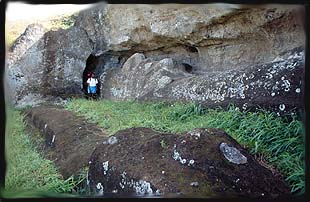 It is unclear why the Easter Islanders turned to statue construction on such a massive scale. Their obsession with it ultimately brought about their downfall as they depleted more and more of the forests for use in the process of moving the giant moai. While the why is a mystery, where it happened and to a large degree how it happened is fairly clear. Each moai was born from the massive caldera of Rano Raraku. (right)
The soft volcanic tuff was perfect material for statue carving. Using harder volcanic rock implements they were able to first sketch out the moai’s outline in the rock wall and then systematically chip away at it until the moai was held in place by a thin “keel.”
The moai carvers were master craftsmen who had risen through the ranks of a “carver’s guild.” The production of the statues was most likely through conscripted labor with many rituals and ceremonies performed throughout the process. The stone carvers were ingenious in making the most out of sections of rock. moai can be seen carved in all directions in the cliff face. If a defect would appear in the rock the statue would be abandoned and they moved on to another area. They took advantage of fissures in the volcanic walls and also variations in colors. In short they were true artists.
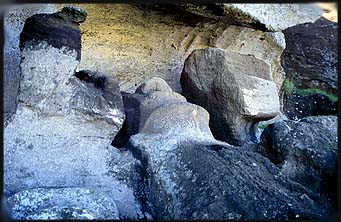 Finally when a statue was finished, it was broken off its keel and slid carefully down the slope using ropes tied to giant palm trunks which were sunk in specially prepared holes in rim of the crater. At the base of the crater they were raised up and final decorations were carved into its torso and back. Coral and obsidian eyes were placed in as a final touch, although some suggest these were only placed in the statues on special occasions. Preparation was then made for transport across the island to various ahu.
The ahu were the ceremonial platforms built to support collections of moai. As evidence of the difficulty moving the moai, many can be seen along the paths of ancient roadways where they broke along the way and were abandoned.
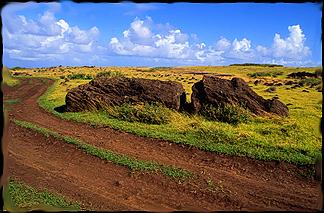 It is believed that the statues were commissioned commemorative images of lineage heads. However, the moai are not portraits of specific individuals although some may have inscriptions or other markings that linked them with specific chiefs. Why they chose the stylized design of the angular face and long phallus shaped bodies is unclear and is one of the greatest mysteries of the Rapa Nui.
While there are some other stone sculptures made by Polynesians, none is similar to the moai. In parts of South America, some statues have been found which resemble the “kneeling” statue on Rano Raraku, but nothing anywhere else resembles the standardized moai design that the Rapa Nui carved over a thousand times.
3. Erecting the Moai
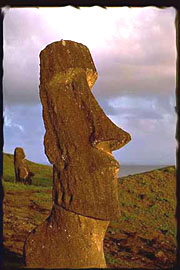 Once the statues were reasonably complete, they then had to be transported across the island to the platforms prepared for them. This involved a trek of 14 miles in some cases. How were these massive Moai moved to the sites? Barring any extraterrestrial influence it seems likely that they were rolled along the ancient roads that crisscrossed the island on logs lubricated with the oils from palm trees. Some suggest that they were moved in an upright position and kept stable by crews manning ropes. This mode would verify the island legends of the statues “walking” to their sites. From a distance seeing one of these great Moai moving along the road bobbing up and down as the logs moved underneath would surely have looked like a statue moving under its own power with a procession alongside it. What a sight that would have been!
 However, recent computer simulations by Jo Anne von Tilburg at UCLA have shown that it would have been much simpler to position the Moai in a horizontal position on two large logs and then roll the whole unit along on other logs placed perpendicular to it. Using this method Van Tilburg calculated that an average moai could have been moved from the quarry to Ahu Akivi in less than 5 days, using approximately 70 men. Her theories were recently put to the test in a successful experiment to move a moai replica on Easter Island sponsored and filmed by Nova (see Resources section)
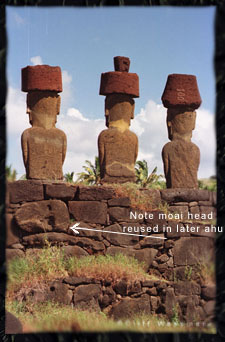
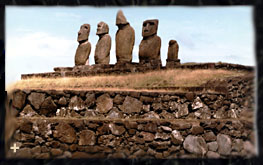
Once the journey was complete the Moai were positioned atop great platforms called ahu. Built at the edge of the ocean, the ahu required just as much engineering know-how and raw labor as the statue construction itself. It is here that the Easter Islanders’ stonework skills can fully be appreciated. As seen in the images to the right of Ahu Naunau and Ahu Tahai, massive blocks and tons of fill were required to build the supports for the moai. Although they were an incredible engineering feat, most of the ahu built were less than elegant constructions. At one mysterious site, however, it was much different.
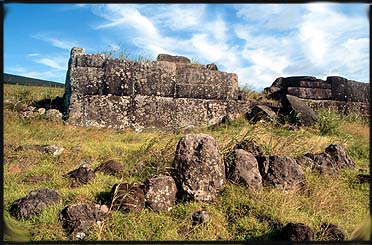
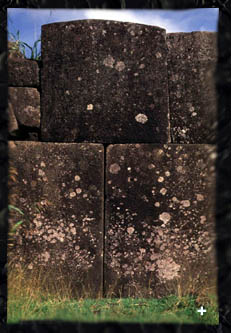
 The stonework of Ahu Vai Uri (right) is compared to that of Ahu Vinapu (below) on the southern shore near Rano Kau. The detail shot shows the incredible precision in the stone fittings. It was this precision, so similar to the stonework done by the Incas, that gave Thor Heyerdahl the idea that the Easter Islanders had come from South America in reed boats on the prevailing currents. Stonework of this complexity had not been seen in Polynesia, but it was common in Peru. It’s impossible to look at that site and not think of the exact type of stone fitting which is so common in sites like Machu Picchu. Most archaeologists consider the similarities a coincidence. If so, it is a remarkable one.
 Soon ahu with erected moai were installed on all corners of the island, until over one thousand had been carved, and the population of the island also continued to grow. For decades the competition to build the biggest and best moai went on, and different ahu – each belonging to a different clan – formed an almost unbroken line along the coast of Easter Island. The culture had reached its zenith. And then something went terribly wrong . . .
4. Conflict: The Fall of the Moai
 A chilling story of resource exploitation and destruction on Easter Island is beginning to come to light. The first westerners to discover the island wondered how any one could have survived on such a desolate, treeless place. Indeed, this was a mystery until recent core samples taken from the crater lakes showed that the island was heavily forested with a giant now-extinct palm while the Easter Island culture was active.
Apparently the islanders were greeted with a lush tropical paradise when they first discovered it. It must have seemed inexhaustible. The trees were cut for lumber for housing, wood for fires, and eventually for the rollers and lever-like devices used to move and erect the moai.
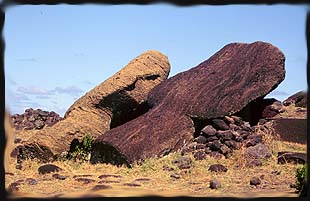
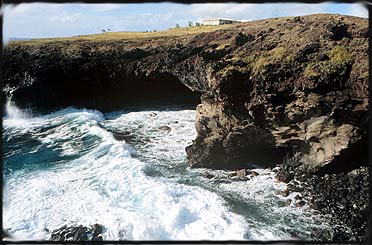 As the deforestation continued the moai building competition turned into an obsession. The quarry was producing moai at sizes that probably could never have been moved very far (one unfinished moai in the quarry is 70 feet tall!) And still the trees came down. With the loss of the forests, the land began to erode. The small amount of topsoil quickly washed into the sea. The crops began to fail and the clans turned on one another in a battle for the scarce resources. The symbols of the islanders’ power and success, the moai, were toppled. Eyes were smashed out of the moai and often rocks were placed where the statues neck would fall so it would decapitate the moai. The violence grew worse and worse. It was said that the victors would eat their dead enemies to gain strength, bones found on the island show evidence of this cannibalism. With the scarce food supplies it may have been a question of hunger as well as being ceremonial. A spooky cave (right) at the southwest corner of the island, Ana Kai Tangata, is translated to “cave where men are eaten.” Inside are pictographs painted in ochre and white of ghost like birds flying upwards. With no wood left to build boats, all the Rapa Nui people could do was look enviously at the birds that sail effortless through the sky. The Rapa Nui culture and community, which had developed over the past 300 years, collapsed.
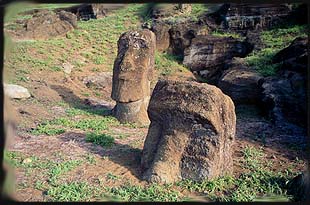 Their island was in shambles, and their villages and crops destroyed. There was no wood left on the island to build escape boats. The few survivors of the conflict, perhaps numbering as low as 750, began to pick up the pieces of their culture. One thing they left behind, however, were the moai….
5. A New Cult Rises
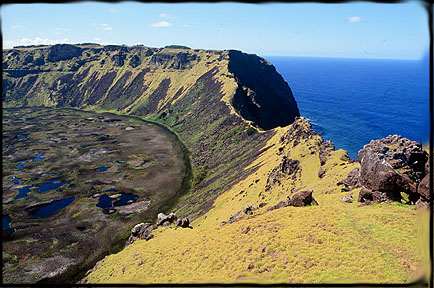 The Easter Islanders were more cut off from the world then ever before. Any dreams of escaping the destroyed island were dashed by the lack of wood. The only boats they could build were small rafts and canoes made of tortoro reeds. Even fishing must have become extremely difficult at this point. The island was a wasteland, the eroded soil just barely producing enough food for the meager population to survive. It was under these conditions that the Birdman Cult arose.
Above: The rim of Rano Kau became the center of the Easter Island Birdman Cult
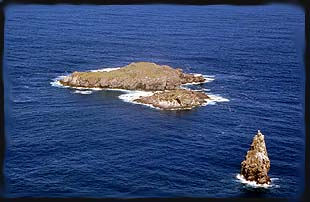 It’s possible that the Birdman practices had been going on during the reign of the statue cult; however, it eventually took over as the predominate religion on the island and was still in practice up untill 1866-67. High on the rim of the crater known as Rano Kau was the ceremonial village of Orongo. Built to worship the god of fertility, Makemake, it became the site of a grueling competition.
Each year leadership of the island was determined by the individual who could scale down the vertical slopes, swim out to one of three small islets in shark-infested waters, and bring back the egg of the nesting sooty tern unbroken. The one who did this successfully was considered the Birdman of the year and was bestowed with special honors and privileges.
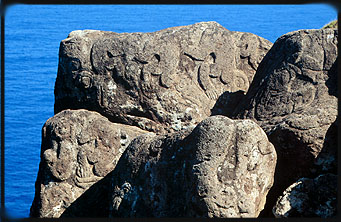
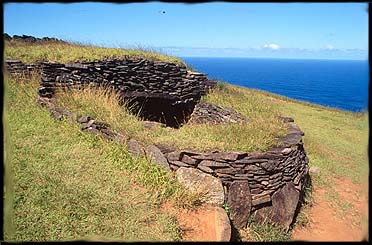 One of the most fascinating sights at Orongo are the hundreds of petroglyphs carved with birdman and Makemake images. Carved into solid basalt, they have resisted ages of harsh weather. It has been suggested that the images represent birdman competition winners. Over 480 Birdman petroglyphs have been found on the island, mostly around Orongo.
As Birdman images transformed the rocks, so too were the islanders transformed. It seemed that the culture was beginning to rebuild itself. We will never know whether the Rapa Nui would have survived and prospered, because in 1862 wave after wave of slave traders landed on Easter Island and took away all healthy individuals. In the space of one year, a level of injury, death and disease was inflicted on the population leaving a broken people, bereft of leadership. As their culture lay in disarray a new force entered the scene whose actions would forever deny the world of a true understanding of the Rapa Nui culture.
 The missionaries arrived on Easter when the people were at their most vulnerable. With their society in ruins it did not take long to convert the population to Christianity. First to go was the islanders style of dress, or lack thereof. Tattooing and use of body paint were banned. Destruction of Rapa Nui artworks, buildings, and sacred objects, including most of the Rongo-rongo tablets – the key to understanding their history – was swift and complete. Islanders were forced off their ancestral lands and required to live in one small section of the island while the rest of the land was used for ranching.
Eventually all pure Rapa Nui blood died out. Annexation with Chile brought new influences, and today there are only a few individuals left with ties to the original population.
6. A Lesson from the Past
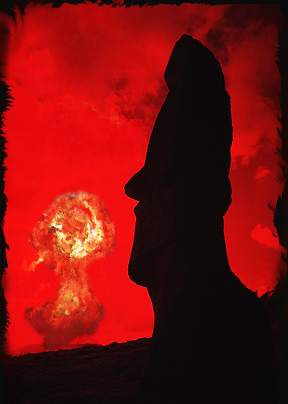 A jewel of an island floating in an endless sea. A seemingly never-ending supply of raw materials. Technological advances. Population growth. Depletion of resources. War. Collapse. Sound familiar? The Easter Island story is a story for our times. We too are on an island floating on an endless sea. There are differences, of course. It could be said that Easter Island is tiny and that it was only a matter of time before the resources in such a closed system were used up. But there are parallels between the islanders’ attitude towards their environment and our own, and this is the most frightening part of the story.
On an island as small as Easter, it was easy to see the effects of the deforestation as it was taking place. But the inhabitants continued their destructive actions. They probably prayed to their gods to replenish the land so they could continue to rape it, but the gods didn’t answer. And still the trees came down. Whatever one did to alter that ecosystem, the results were reasonably predictable. One could stand on the summit and see almost every point on the island. The person who felled the last tree could see that it was the last tree. Nonetheless, he (or she) still felled it.* This is the really scary part. As our own forests fall to the bulldozers, there are many who are valiantly trying to save them. It is obvious, now that we have satellites showing us the massive deforestation, that there is a serious problem. And yet our leaders — and even the majority of individuals — look on, unconcerned. They appear willing to bulldoze the last trees to build the moai of our time — technology & development. Will we have the sense to reconcile our lifestyles with the well-being of our environment, or is the human personality always the same — as that of the person who felled the last tree?*
*from the book Easter Island-Earth Island
A Tour of the Island
1. Rano Raraku
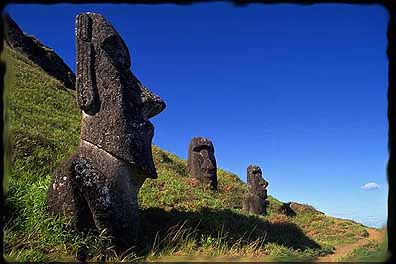 Almost everyone has seen the iconic images of the Easter Island statues staring silently out from the hillsides. For years I thought these were the only Moai on the island. I knew nothing of the statues erected on ahu or the fallen moai at the other sites. Seeing these pictures many people have come to believe that all Moai faced the ocean while it is the exact opposite that is true. With the exception of Ahu Akivi all erected Moai face inland. It is believed they were positioned that way to watch over the villages.
At Rano Raraku the statues face away from the crater.The fact is these statues were not meant to have stayed in this place. The Moai that you see half buried on the sides of the volcanic cone of Rano Raraku were pieces waiting to be transported to ahu around the island. The Moai that you see sticking up out of the ground have bodies that extend down underground 20 – 40 feet, all the way to the waist. Centuries of erosion from the slopes above have covered all but the tops of these giants – the largest Moai ever constructed. One of the unfinished moai, completely carved but not removed from the crater wall, is a staggering 70 feet in length. Many doubt this statue could ever have been raised successfully. Giving their ingenuity and obsession, I believe they would have eventually. The slopes of Rano Raraku are filled with eye-less moai – several hundred circle the crater in various stages of construction.
Many have a more detailed and finished look than the moai erected on the island’s ahu. There are some that disagree that these statues were finished pieces waiting for transport and believe that they were never meant to be move from the slopes surrounding their birth place. Perhaps it was a “Moai Showroom” of sorts where local leaders could come and pick out their favorite design!The Statue shown on the left is my personal favorite. It’s thin deeply chiseled features make it unique among the Moai. At over 45 feet tall it must have been extremely difficult to carve and move.
Thor Heyerdahl’s team was given one day in 1987 to excavate and measure the full length of the moai. Its regal head tapers into a long thin body with carved tattoo and loin cloth relief’s on its surface. It has a distinctly phallic shape to it and some have proposed that all the moai were purposely designed around a phallus shaped form.
The interior of the caldera contains many finished and unfinished moai as well. Erosion has covered many nearly completely and it’s possible more lay beneath the ground, covered by hundreds of years of erosion. The potmarked walls from which the moai where carved can clearly be seen in this photo taken of the interior of the Rano Raraku caldera just above the crater lake. Right: Statues located on the interior slopes of Rana Raraku. Centuries of erosion have buried many of the Moai around the rim of the caldera.
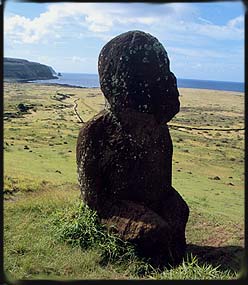 Finally the strangest Moai ever found on Easter Island. The odd “kneeling” statue. Found by archaeologist Thor Heyerdahl’s team in 1955 on a part of the Rano Raraku quarry near no other statues it stands, hauntingly. It is a very realistic piece compared to the traditional moai and it is unclear whether this was a very early piece or a later development. Its location, away from the other carved moai is also unusual. One legend says that this is a representation of a famous moai carver, erected to watch over future generations of the craftsmen
There is something about this statue that makes the hair on the back of my neck stand up. I can’t put my finger on what it is but as I stood there looking at it with the howling tradewinds blowing through my ears, I knew there was a story here that had not been told. It’s as if the statue is trying to scream out, to tell us what happened. But it’s mouth is solid basalt and winds block out any sound.
2. Ahu Tongariki
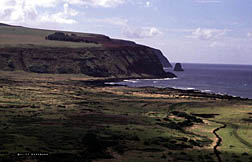 Ahu Tongariki, on the south coast of Easter was the site of one of the largest of the ahu. The large flat plain below Rano Raraku provided easy access to the quarry and as a result the largest of the moai where erected here.
However, in 1960, a massive tidal wave generated by an earthquake off the coast of Chile hit Ahu Tongariki and destroyed the platform and swept the massive moai hundreds of yards inland.
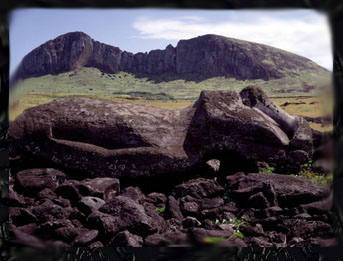 Right is a rare picture of one of Ahu Tongariki’s moai against the backdrop of its birthplace – the Rano Raraku volcano. The photo is rare because in 1992 a team from Japan brought in cranes and other heavy equipment. Their mission: restore Ahu Tongariki. Working under the direction of Chilean archaeologist, Claudio Cristino the task took five years. Now all 15 of the moai stand proudly once more at what is arguably Easter Island’s most impressive site.
While the new restoration is impressive there was a stark beauty to the site in its demolished state that has now been lost. While it is tempting to raise all the moai that have been toppled due to the war on the island or natural events, part of the history is altered by doing so. Due to the harsh weather conditions some statues are better protected in their fallen state.
3. Ahu Vinapu
Ahu Vinapu is not as spectacular as some of the other sites on Easter Island. There are no erected moai, no giant craters to peer into, and it’s views include the airport fuel tanks. But at Ahu Vinapu, to some, stands evidence that flies in the face of what modern archaeologists want us to believe about the people that built the ruins.
At Ahu Vinapu we see a style of stonework not found at any other Polynesian site. This is the only site on Easter where this level of workmanship is shown as well, however, other sites had existed but were torn down by the missionaries to build houses.
While this type of precise stone fitting is nonexistent in Pacific Island cultures, it is common among South American cultures that occurred before and during Easter’s occupation. It is this striking similarity that has lead some, most notably, Thor Heyerdahl, to suggest that it is evidence that South Americans colonized, or at least were present on Easter Island, and influenced the culture. (see the controversies section) One other mystery is that Ahu Vinapu is considered to be a fairly early site. Generally you would assume that an earlier site would have less craftsmanship involved than a later site, yet, in this case we see the reverse.
Although all that remains visible at Vinapu now are the broken remains of an ahu, reports from as late as 1816 say moai where standing at the site. There are several buried around the ahu with only their faces visible.
 Largely unrestored, there is an erie feeling at this place. The blood red scoria column, the half buried faced peering at you from the grass, and a small broken wall from what was obviously a massive structure, all combine to really strike home the failure of this unique culture.
Clearly, Ahu Vinapu was an important site. Captain Cook’s logs tell of up to 20 moai erected in this area. The remains of red scordia monuments have also been found on the site including a rare column-like monument whose carvings and meaning have eroded forever.
Are these walls the proof of South American influence or just as one archeologist put it: “there are only so many ways to carve a rock.”
4. Ahu Akivi
Built in 1460 this site was one of the later constructions built, probably at a time when the statue cult was beginning to unravel. Unlike other sites, Akivi is inland and has a commanding view of the western part of the island. Its 7 moai, all about 14 feet tall and approx. 12 metric tons each, are remarkably similar. When UCLA archeologist Jo Anne Van Tilburg documented all the statues on the island the Ahu Akivi statues were found to be the statistical average of all the moai.
The statues were raised and the site restored in the 50’s by famed archeologist William Mulloy. Studies suggest that the ahu itself was begun around 1442 and lasted until 1600. Van Tilburg has postulated that during that time 8 chiefs of this region could have ruled. It is thought that perhaps the statues where build by the 8th chief who was most likely a direct descendant of the others. As statue construction stopped about this time this 8th chief never got his due after building such an austere and beautiful monument. I found myself returning again and again to this site during my visit to Rapa Nui. After photographing it in every possible light I realized that night a full moon would be rising in the area.
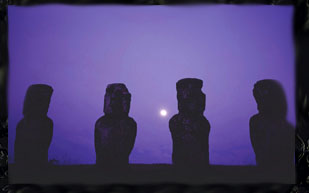 I didn’t know exactly where it would rise but I stayed at Akivi in the hopes I could get a shot of it alongside a moai. As I sat directly in front of the center of the line of moai the moon rose up and over the ahu perfectly aligned with the center. Little has been written about any relation between celestial events and the positioning of the ahu although it is suspected that in at least 12 sites there was some connection.
As I sat and watched the moonlight illuminate the moai I tried to imagine what would have been happening at this site 400 years ago.
5. Ahu Naunau
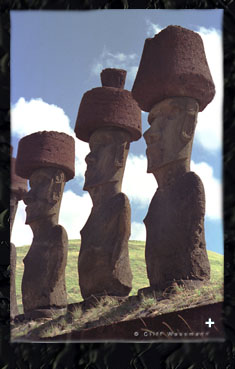 The legends of Easter Island say that Hotu Matua came first came ashore here at Anakena Beach and that this was the island’s first settlement. Excavations of the site have confirmed that it had been occupied for a very long time. The current ahu is built upon the remains of several others and the same precise stone work is found in the buried ahu as that of Ahu Vinapu. Again, this is curious because one would expect the more advanced stonework work have been done during later periods of the island’s development.
What is striking about the statues at Ahu Naunau are the red scoria headdress’s (known as Pukao) that fit on the moai heads. These were carved from a different quarry than those of the moai that contained a large quantities of the red lava rock. Many of the moai on the island originally had pukao and they are found alongside the fallen statues in many sites. It is believe that they where installed by building a ramp of stones up the side of an erected moai and then rolled up where they could be placed on the top. Afterwards the ramp was disassembled.
As for why the Rapa Nui began putting the pukao on selected moai remains a mystery. Heyerdahl, referring too the mysterious red headed race that was reported on the island concluded that they represented topknots of red hair. Other archeologists point to the tradition of placing a large stone on the image of a dead leader as a sign of death and mourning.
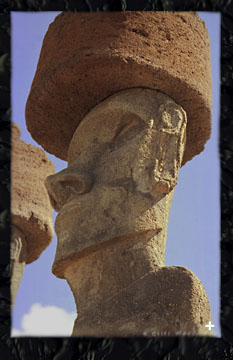 The statues at Ahu Naunau are also known for the detailed carvings on their backs. Along with traditional loin cloth reliefs are fishhook patterns that are found on none of the other statues.
The detail work in the statues at Ahu Naunau is truly remarkable. Precisely chiseled facial features, the now familiar long ears and thin lips are all carved on the Ahu Naunau statues to a degree not seen at other sites. Although, not the biggest of the moai, they are clearly the most refined. A fitting tribute if this is, indeed, the site of Rapa Nui’s first settlement.
It was at Anakena that one of the island’s secrets was finally discovered. Archeologist long puzzled over the deep eye sockets of the moai that had been erected. Could it be that the moai had in fact had eyes?
In 1978, a student named Sonia Haoa found fragments of worked coral and a red disk made out of scoria, the same material used to make the pukao. When fitted together they made an unmistakable eye. She brought the fragments to archeologist Segio Rapu who discovered they fit precisely in the eye socket of a moai. So, the moai did have eyes, although, it is unclear if they were permanent fixtures of the statues or placed in them only on ceremonial occasions as is done now on the island with replicas of the eyes.
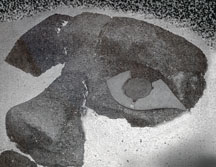 The most complete eye found to date, on view at the museum on Easter Island
6. Ahu Tahai, Ahu Vai Uri
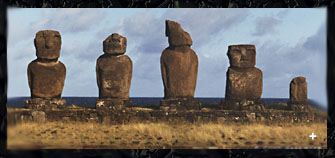 On the island’s western shore lay the ruins of a very unique ahu. It is unique in that the statues erected on it are all very different from each other both in scale and shape. There is a the large figure in the center, with two figure of similar size on its left. Then to the right we have a smaller, squatter figure and the remains of an even smaller statue. Why is there variation of the moai at this ahu and not at the others.
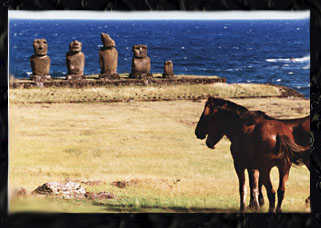 This site seems to clearly show an attempt to create some individualism in the statues while keeping the basic stylistic design. Whether this is depiction of a group of leaders of a clan as is generally assumed at other sites or represents an actual family unit is a matter of debate. One could look at these figures and see a king with two sons on his left, and his wife and another child, perhaps a female on the left. Due to its incomplete condition the smaller statue will remain a mystery forever. Perhaps it was a leader that died young like King Tutankhamen of Egypt.
This place had a haunted feeling to it. I was drawn to it again and again and I produced some of my best photographs of the trip.
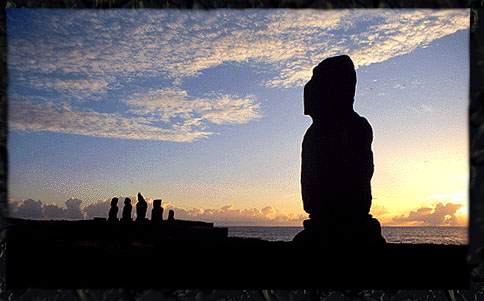
7. Rano Kau and Orongo
Our final site is not known for its giant moai or dramatic ruins but for its natural beauty. It is not until you get to the very top of the trail that you see the view. And what a view it is. I literally fell to my knees in awe when I first saw it. A giant caldera stretched out before me. Glistening lakes and marshes dotted the floor of the crater. Hawks rode thermals along its green and brown streaked walls. With the tradewinds trying to left me up – and myself almost willing to let them – I peered over the other side. The knife edge crater wall drops 1000 feet to the deep blue sea. Between the curvature of the earth and the circular edge of the caldera one gets a strong sensation of vertigo. This was the final setting for Rapa Nui culture. It was here on the crater’s rim that they built the village of Orongo. Up until the 1878 the islanders practiced ancient rights and tests of skill. Most famous was the ritual whereby Rapa Nui would scale down the sheer cliffs, swim through shark infested water and then fast on the tiny islets off shore waiting for the first sooty tern to lay her eggs. The winner of the competition had special rights and privileges granted them for the duration of the following year.
The rocks at Orongo are carved with hundreds of petroglyphs of birdman. The sea birds, especially the frigate bird, became an important symbol for the Rapa Nui. As frigates nested in trees, they became more and more scarce due to the deforestation on the island. Changing weather conditions as well as over hunting also contributed to decrease in the number of other bird species. Although the birdman cult seems to have overtaken the statue building cult there are ties between the two. In on of the houses at Orongo was found an 8′ high moai, complete with sacred loin cloth bas relief carved on it. But superimposed over the moai body are birdman and other symbols of the Orongo practitioners. So it appears that the two groups had some how come to terms with the differing beliefs that were present on the island.
I am often asked if I felt anything mystical while on Easter. Often, alone and with the ever-present tradewinda howling in my ears, I felt a deep sense of loss on the island. One feeling kept rising up in me again and again as I climbed among the unfinished moai on the barren walls of Rano Raraku. It was the feeling of failure. I believe the Rapa Nui knew they were special people and in the end they knew they had only themselves to blame.
Controversies
 For reasons still unknown they began carving giant statues out of volcanic rock. These monuments, known, as “moai” are some of the most incredible ancient relics ever discovered. The people of Easter Island called themselves the Rapa Nui. Where did they come from and why did they disappear? Science has learned much about the enigma of Easter Island and has put to rest some of the more bizarre theories, but questions and controversies remain.
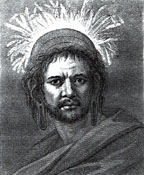
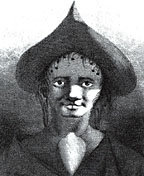
 Darwin pointed out how groups of animals living in remote places eventually take on unique characteristics and eventually turn them into distinct species. Such is the case with the people of Easter Island. As unique as a culture as they had become, the Rapa Nui left clues as to their origins in their language, art, and beliefs. Contemporary archeologists think it’s an open and shut case – the first and only people ever to live on Easter Island were from an individual group of Polynesians that, once finding Easter, then had no contact with any other races.Until of course, that fateful day in 1722 when, on Easter Sunday, Dutch commander Jacob Roggeveen, became the first European to “discover” the island. What his crew witnessed and recorded once on the island has fueled speculation about the origins of the Rapa Nui ever since. Explore this site to get the latest information on the island’s history and current research.
They reported a mixed race island with both dark skinned and light living together. Some were even described as having red hair and being sun-burnt looking! This does not fit well in the Polynesian only scenario and despite recent evidence that backs up a migration from another island in the South Pacific, archeologists still must argue the claims of the most well-known, but now, outcast archeologist/explorer Thor Heyerdahl.
Roggeveen’s notes tell of the islanders being organized into several classes. The light skinned islanders wore large disks in extended earlobes. Their bodies were heavily tattooed and they worshipped the giant statues and performed ceremonies before them. How could light skinned people be living amongst Polynesians on such a remote island? According to Heyerdahl Easter Island was settled in stages over a period of years by at least two different cultures. One from Polynesia and the other from South America, possibly Peru, where mummies of red -headed individuals have been found along side those of black hair.
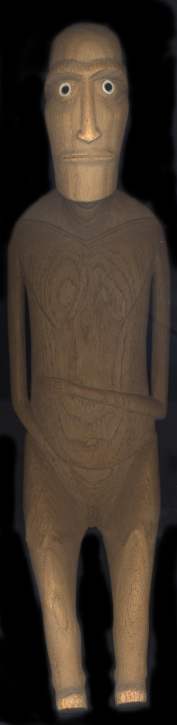
Heyerdahl also points to similarities between stone monuments in Bolivia that resemble the “kneeling” statue found on Rano Raraku. In Heyerdahl’s view, the sea was alive thousands of years ago with large ocean going canoes that discovered and colonized islands far earlier than history suggests. He points to stories of an advanced Redheaded race in South America and currents that swept from Peru to Easter Island and his own famous trip in 1947 on a reed raft known as the Kon-Tiki expedition.
Contemporary archeologists will have none of it. They point to the long history of Polynesian settlement in the South Pacific and linguistic evidence that they say places origins most likely in the Marquesas or Pitcarn Island.
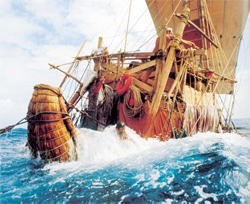 Heyerdahl, they say, dismisses Easter Island legends that speak of an origin from the west. Occording to them botanical and anthomorphic data collected clearly back up their view that the island was colonized only once from the west.
The attacks against his beliefs have been almost universal from the archeological community which will not even refer to Heyerdahl as an archeologist anymore. Heyerdahl has made it clear the feeling is mutual. Both sides in the debate accuse each other with making the evidence fit their own beliefs.
But there is a third origin story that as far fetched as it seems has scientific proof behind it. Around 1536 a Spanish ship, the San Lesmems was lost near Tahiti. Legends tell of the Basque survivors intermarrying with the Polynesians. Either they or their descendants set off from Tahiti to try and return home in the 1600’s and were never seen again. Interestingly, genetic testing of pure blood Rapa Nui revealed the presence of Basque genes.
Could Easter Island have been settled by a lost crew of Polynesian and Spanish seafarers? Perhaps science will eventually give us a definitive answer on who the Rapa Nui were. Where ever they came from, the Rapa Nui were an amazing people. They built a highly organized and efficient society on a tiny island out of little or nothing and in the few short years it existed created an enigma that has puzzled the world ever since.
How were the Moai Moved?
Did the Rapa Nui move the moai upright, like giant refrigerators?
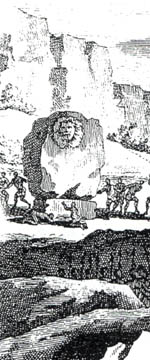 A Dutch drawing from 1728, right, seems to show natives moving an Easter Island statue in an upright position. Although it is unclear in this image whether what is being depicted is moving or erecting, Thor Heyerdahl was told by village elders that the statues walked from the quarry to the ahu. While this seems fanciful some have considered that it meant the statues where moved in an upright position.
Several experiments were carried out and although it was proven that the statues could have been moved by rocking and rolling their bases similar to the way we would move a refrigerator or large piece of furniture, the method would have caused so much damage to the base of the statue that it would seem an unlikely method except when the statue was at the end of its journey and ready for final positioning.
In the Dutch illustration, the statue is clearly on a base of some sort and workers are in the process of doing something underneath the base while others pull. American Geologist Charles Love, in a series of experiments, successfully moved a replica moai by placing it on two logs cut to fit into the bottom of the statue. When raised onto a track of wooden rollers he found that his 10 ton moai could be moved 145 feet in just a few minutes using 25 men and two ropes. Of course it would not be as easy over rough terrain and hills but the idea was plausible and fit with the “walking moai” stories.
One archeologist has a different idea. Jo Anne Van Tilburg of UCLA has become one of the premier scientists studying the Easter Island mystery. Her work has led to a complete cataloging of all know moai on Easter with measurements of every element the statue.
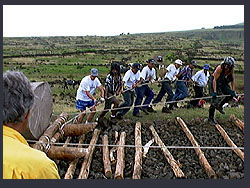 Using computer models that took into account manpower, available materials, type of rock, and the most efficient route for transport of the statues across the island to the various locations which they had been erected in the past, and even how much food the workers would need to eat, Van Tilburg has created a convincing scenario for the most probable mode of statue transport. In her view the statues were move in a prone position.
The statue was lain prone on two long logs positioned vertically. Under these were placed smaller logs upon which the carrying logs were rolled. After plugging in all her data the result was that a standard size moai cut be moved from Rano Raraku quarry to Ahu Akivi (a distance of 10.1 km) by 70 individuals in 4.7 days. But how would this theory play in the real world? To find out, Van Tilbert set out for Easter Island with a team from the PBS show NOVA in April 1999. Her successful tests proved that the moai could have been moved by her methods. They did not prove, however, that this was they way they were moved.