Contents
Introduction
Deep within the jungles of Mexico and Guatemala and extending into the limestone shelf of the Yucatan peninsula lie the mysterious temples and pyramids of the Maya. While Europe was still in the midst of the Dark Ages, these amazing people had mapped the heavens, evolved the only true writing system native to the Americas and were masters of mathematics. They invented the calendars we use today. Without metal tools, beasts of burden or even the wheel they were able to construct vast cities across a huge jungle landscape with an amazing degree of architectural perfection and variety. Their legacy in stone, which has survived in a spectacular fashion at places such as Palenque, Tikal, Tulum, Chichén Itzá, Copan and Uxmal, lives on as do the seven million descendants of the classic Maya civilization
 The Maya are probably the best-known of the classical civilizations of Mesoamerica. Originating in the Yucatan around 2600 B.C., they rose to prominence around A.D. 250 in present-day southern Mexico, Guatemala, northern Belize and western Honduras. Building on the inherited inventions and ideas of earlier civilizations such as the Olmec, the Maya developed astronomy, calendrical systems and hieroglyphic writing.
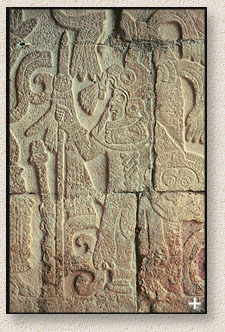 The Maya were noted as well for elaborate and highly decorated ceremonial architecture, including temple-pyramids, palaces and observatories, all built without metal tools. They were also skilled farmers, clearing large sections of tropical rain forest and, where groundwater was scarce, building sizable underground reservoirs for the storage of rainwater. The Maya were equally skilled as weavers and potters, and cleared routes through jungles and swamps to foster extensive trade networks with distant peoples.
Around 300 B.C., the Maya adopted a hierarchical system of government with rule by nobles and kings. This civilization developed into highly structured kingdoms during the Classic period, A.D. 200-900.
Their society consisted of many independent states, each with a rural farming community and large urban sites built around ceremonial centers. It started to decline around A.D. 900 when – for reasons which are still largely a mystery – the southern Maya abandoned their cities. When the northern Maya were integrated into the Toltec society by A.D. 1200, the Maya dynasty finally came to a close, although some peripheral centers continued to thrive until the Spanish Conquest in the early sixteenth century.
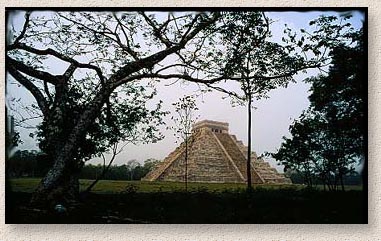
El Castillo
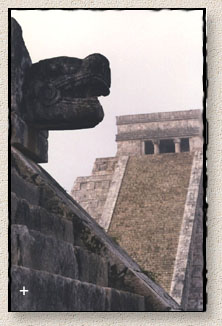 The massive Kukulcán pyramid called “El Castillo” (the castle) is roughly at the center of the site. Climbing it is quite a challenge and those who make it are rewarded with a spectacular view of the city and surrounding country side. A trip inside the pyramid is quite the opposite. The dark, unbearably humid corridors and chambers are too much for some people.
Early morning, before the onslaught of tourists, Chichén Itzá is a magical place. I had the opportunity to wander around the site for two hours before the gates were opened one day. Watching the massive pyramid take shape through the lifting fog is an experience I will not soon forget.
The construction of the Kukulcán Pyramid at Chichén Itzá was planned so that each Vernal Equinox the dying sun would cast a shadow of a serpent writhing down the steps of the pyramid. Every year over 40,000 people make the trek to the great pyramid to watch in awe as the snakes diamond backed body slowly appears.
If you stand facing the foot of the temple and shout the echo comes back as a piercing shriek. Also, a person standing on the top step can speak in a normal voice and be heard by those at ground level for some distance. This quality is also shared by another Mayan pyramid at Tikal.
The Temple of the Warriors
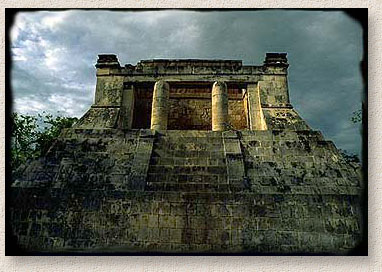
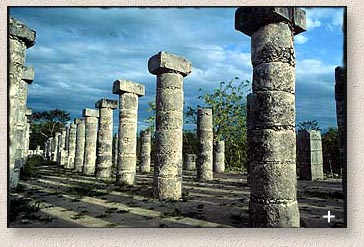 The Temple of the Warriors and its adjacent Temple of the Jaguar are the most awe inspiring ruins on the complex. A massive temple structure, surrounded by hundreds of columns is carved with reliefs. Still early morning, I wandered into the rows of columns with the sun just breaking through.
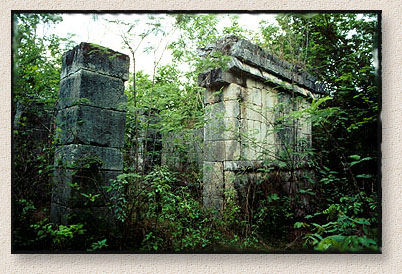
The columns continue on into the jungle, that part of the temple still has not been restored. It’s an unsettling sight to see how easily the forest has reclaimed the area. What unanswered questions lay under the canopy of leaves and beneath the twisted roots.
The Observatory
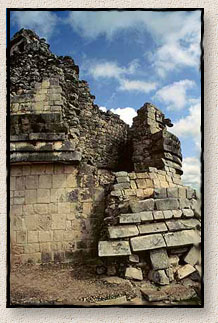 The Observatory The intense interest of the Maya in the annual travels of the sun across the sky is evident in many structures at Chichén Itzá and other Mayan Sites. South of the Castillo is a strange round building known as the Carocal. Several of its windows point towards the equinox sunset and the southernmost and northernmost points on the horizon where Venus rises.
One of the nice things about Chichén Itzá is that you can go in almost all of the ruins. Many have the musty smell of the past, still present after over 1000 years. Dark portals await those that dare walk through. After walking into one pitch black room a startled meter long iguana charged through my shaking legs and out into the jungle. It felt like a seen from “Indiana Jones” It’s nice that despite all the reconstruction and tourists, the place can still grab hold of you like that.
The Nunnery
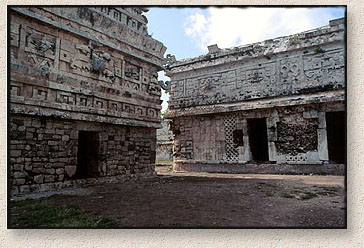 The Nunnery, in the southern group of ruins, contains some of the best preserved structures at Chichén Itzá. They appear to be the living quarters of the elite Mayans. Every square foot of wall has reliefs and paintings decorating it.
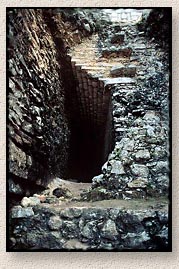 Like most of the other ruins, entry is allowed so I explore some of the hidden recesses. Around the back of a large staircase I discover and ominous black opening. Although it’s been thoroughly explored I’m sure, it feels like I’m the first, so with visions of buried treasure I step into the darkness.
As I probe deeper the walls get tighter and tighter. There are several intersections and turns before it leads to a dead end. A solid wall of limestone blocks the way. In the darkness I reach out to touch it and instead feel something furry and multi legged run across my hand. That does it, I bolt out, back to the 20th century .
The Ball Court at Chichén Itzá
The Mayans were great sportsmen and build huge ballcourts to play their games. The Great Ballcourt of Chichén Itzá is 545 feet long and 225 feet wide overall. It has no vault, no discontinuity between the walls and is totally open to the sky.
Each end has a raised “temple” area. A whisper from end can be heard clearly at the other end 500 feet away and through the length and breath of the court. The sound waves are unaffected by wind direction or time of day/night. Archaeologists engaged in the reconstruction noted that the sound transmission became stronger and clearer as they proceeded. In 1931 Leopold Stokowski spent 4 days at the site to determine the acoustic principals that could be applied to an open-air concert theater he was designing. Stokowski failed to learn the secret. To this day it has not been explained.
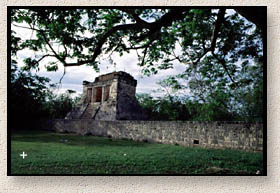 It is not hard to imagine a Mayan King sitting here presiding over the games. Legends say that the the winning captain would present his head to the losing capitan, who then decapitates him. While this may seem a strange reward, the Mayans believed this to be the ultimate honor.The winning captian getting a direct ticket to heaven instead of going through the 13 steps that the Mayan’s believed they had to go through in order to reach heaven..
This concludes the tour of the Chichén Itzá ruins. Just down the road from the Chichén Itzá ruins, however is a natural formation as spooky as the ruins themselves.
The Cenote
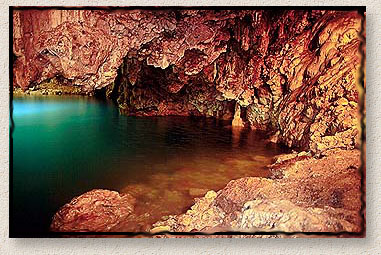 East of the major Chichén Itzá ruins is a dark underground world the Mayans called Cenoté. They are deep water filled sinkholes formed by water percolating through the soft limestone above. Since the porous soil held little water, these underground bodies were extremely important to the city. A visit to one is a spine chilling experience. Entry is through a vertical hole with narrow stair steps carved by the Mayan’s themselves. The air is thick and musty. One misstep on the slimy ledges threatens to send you falling over 20 feet.
Once your eyes get used to the light level a bizarre world takes shape. Stalagtites of blood red limestone seem to ooze from the dripping walls. Ahead is a strange green pool of glowing water. As you approach the pool you notice roots of trees hanging before you. In their search for water they’ve penetrated the ceiling, dropping 50 feet to the pool below. It’s like an eerie underground forest.
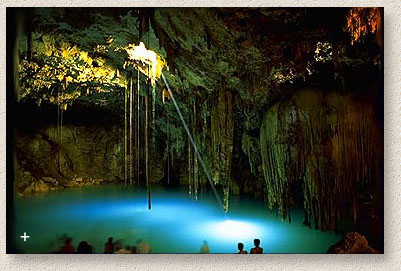 After you’ve crawled under some especially low hanging stalactites you’re greeted by an incredible scene. A beautiful blue green pool of unknown depth stretches out before you. A massive stalactite hangs down, just inches from touching the surface, and above a piercing beam of light streams in from the ceiling, illuminating the pool and the entire chamber.
By pure luck I was at the Cenoté for a rare event. Once a year, in April, the beam of light touches the tip of the stalactite. There are many instances of ancient peoples building monuments to take advantage of events like these but this is something that is totally natural and unplanned.
There is a darker side to this and other Cenoté , however. In the wells around Chichén Itzá have been found scores of skeletons. Mayan carvings depict human sacrifices at these sites.